

“There should be more room for fun in art” – Animated Gif Mashup Studio Workshop with Evan Roth

By Anna Jacobs
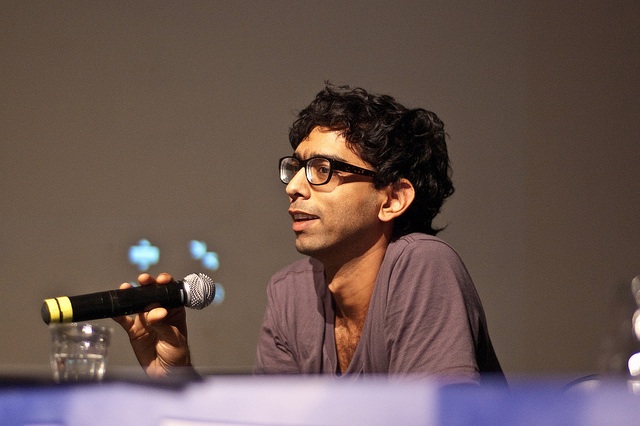
Evan Roth - 'Animated Gif Mashup Studio Workshop'. Photo by Anne Helmond.

Evan Roth - 'Animated Gif Mashup Studio Workshop'. Photo by Anne Helmond.

Last Thursday (10-03) I attended a workshop about animated gif mashups led by the artist Evan Roth. Twenty minutes before the start of the workshop the room was already filled with enthusiastic students, no doubt because of Evan’s well-documented reputation when it comes to lively workshops. The audience included a variety of New Media-, Interactive Media-, Audiovisual Media-, Media & Information- and Media Design students, some from the Netherlands, but also a few exchange students from Austria, Curacao and Argentina. All the participants were asked to bring their computers for the workshop. Evan Roth immediately gave his session an informal tone, by kicking off with: “I’ve never done this workshop before, I just want to have fun and make some video mashups with you guys”.

He quickly introduced us to his earlier projects for the Graffiti Research Lab and the Free Art & Technology lab. As an artist, Evan is outspoken about open source and free culture. This is exactly what the F.A.T. Lab is about: an organization dedicated to enriching the public domain, by keeping all the content in the public domain. Its disclaimer states: ‘you may enjoy, use, modify, snipe about and republish all F.A.T. media and technologies as you see fit.’ However, the workshop during the Video Vortex wasn’t about activist issues or promoting free culture, but about making gifs.

We all know gifs, or graphic interchange formats, probably as those geeky granular images of dancing people or singing cats. Their old school image is why Evan things they’re cool. But I was still wondering why Evan decided to let us work with gifs. I had in mind that his answer would have something to with open source and free culture, since everyone is free to collect and spread gifs and use them for other purposes. But he surprised me by saying that his main point for that day was just having fun. “There should be more room for fun in art”. He told me how his other lectures and workshops were more directly linked with politics, but that he felt like really doing something else this day. He wanted us to just play with gifs, get our hands dirty. He did add that he clearly sees how gifs are important in an ideological sense, since they create some sort of overall image of the internet right now, they’re all small time capsules. So from a historical point of view it is important to curate them somewhere where they can’t get lost.

The future of the ubiquitous gifs? Hard to say, according to Evan. He feels they had their peak in 2010, when ‘We Make Money Not Art’ started growing bigger and bigger. At the beginning of the internet era gif and jpeg were the standard form, but slowly they were overtaken by png and flash (for movies). This is why Evan isn’t sure how gif will develop in the upcoming years, so most important is to make sure that all previous gifs are saved in a good database.

Since there weren’t any students in the room who already had any experience with making mash ups, Evan gave a quick demonstration and showed us some of his work. After making sure everyone was connected to the internet, he showed us Private Pad, the ‘public chatroom’, we’d be using for sharing links and FileZillah where we could put the gifs we’ve found on the internet. Using gifmashup.evan-roth.com (an open source animated gif mash-up software built by Evan), we could add a couple of gifs together to make a mashup. He gave us a few links to GIF collections, like Dump, Heathersanimations, Gifsoup and Tumblr. The rest of the workshop there was filled with the buzz of a great atmosphere. Everyone was actively searching and sharing gifs and Evan filled the room with songs varying from Biggie to the Beatles, looking for a suitable song to accompany our collective mash up. When the server started crashing since the input was so great (we filled three folders with gifs), Evan decided to let us vote for a song and started to create the mash up. Sadly we were running out of time, so we only got a sneak peek of our work, but it already looked great.

Evan’s mission was definitely accomplished, his workshop surely was a lot of fun.

The results of the workshop:

Online Video Art: Ashiq Khondker and Eugene Kotlyarenko Play with the Diegetic Desktop

Ashiq Khondker - 'The Diegetic Desktop'. Photo by Anne Helmond.

Ashiq Khondker - 'The Diegetic Desktop'. Photo by Anne Helmond.

Ashiq Khondker and Eugene Kotlyarenko’s presentation was the most entertaining and confusing of the first day of Video Vortex #6. To begin with, their collaboration took place exclusively on the internet, after Ashiq contacted the artist to interview him about a series of videos he shot entirely with screen capture software and published online as a sort of mini-series entitled ‘Instructional Video #4: Preparation for Mission‘. To match the spirit of Kotlyarenko’s pieces, the interview – or the attempts to get it done – were recorded with the aforementioned software and edited into a narrated, self-presented documentary. That is to say, there was no usual speaker-behind-a-laptop combination, but a fullscreen projection of the clip.

Called The Diegetic Desktop, this video showed Ashiq trying to interview an arrogant and downright obnoxious Kotlyarenko via iChat and Skype, while switching between notes and Web browser windows or sharing his screen with the American artist. As the video progressed, it seemed there was no way to deal with Eugene, annoying and uncooperative, lazily slouched on his sofa with a giant bottle of water and a couple of mysterious green pills that obviously didn’t cure his delusions of grandeur.

The apparently failed interview had a big impact on the audience, who became very engaged, asking questions or even calling Kotlyarenko an ‘a**hole’. But then a surprising revelation was made: the whole video was set up. When Sabine Niederer, managing director of the Institute of Network Cultures, complimented Ashiq on his patience in interviewing such a difficult character, he confessed that both he and Eugene had been faking it all along. Ashiq said that playing the goofy guy came naturally to him, while Eugene took on the role of the arrogant artist.

It was not just an entertaining presentation, but an actual piece of video art that, rather than making sweeping statements about the future of online video, showed how diegetic desktop works play with software and our minds.

Online Video Art: Roel Wouters and Conditional Design

By Caroline Goralczyk

Roel Wouters - 'Directing the Audience: What Happens When Media Producers and Consumers Merge?' Photo by Anne Helmond.

Roel Wouters - 'Directing the Audience: What Happens When Media Producers and Consumers Merge?' Photo by Anne Helmond.

In his presentation on online video art and the design of fluid digital environments, graphic designer and project director Roel Wouters introduced the audience to interactive projects which include dynamic media such as web video and animation to install crowdsourced performances. With his collegues Luna Maurer, Jonathan Puckey and Edo Paulus he has published the Conditional Design Manifesto, which is based on the work of his collective called Conditional Design and emphasizes the idea of following processes in the digital realm rather than its products.

In their work, Wouters and his fellow group of designers focus on the increasing blur between consumers and producers which comes about as a result of web technology enabling user participation in the creation of online video art. Roel Wouters presented two projects that are based on users taking part in the installation of a video, one based on people taking pictures of themselves with a webcam, prior given the instruction to resemble a particular frame and one based on creating a video, resembling a particular scene or act.  As if to say “If I would be the director, you would be my actors”, these projects are based on collaborative story-telling in creating online video art which participants can share with their friends online.

It is surprising how these projects result in really beautiful photography. People are not self-conscious when resembling the frame which they are given and that is why they appear very natural” stated Wouters when presenting the two projects “One frame of fame” and “Now Take a Bow” to the audience. His collective Conditional Design was recently involved in the 5days off festival in Amsterdam with a project based on an iPhone application which Routers calls a ‘social photo toy’, resembling ‘the ultimate amateur photo’, which is people taking pictures of themselves in front of a mirror using flash.

Here is an illustration of the ‘One frame of fame’ project:

YouTube Preview Image


Dagan Cohen and Upload Cinema: Taking YouTube to the Big Screen

By Nicola Bozzi

Video Vortex 6

Dagan Cohen - 'Upload Cinema: Bringing Web Film to the Big Screen: from Nice to Mainstream'. Photo by Anne Helmond.

Upload Cinema is a monthly video spree that quite literally takes the most valuable YouTube gems to the big screen. That is, the not-so-big one of the Uitkijk, the smallest and coziest movie theater in Amsterdam.

Dutch creative director Dagan Cohen and cinema programmer Barbara de Wijn started the initiative because they thought (the best) YouTube videos deserved a bigger screen. So, to make sure they selected only the most compelling, they made the format of their cinematic get-together strictly editorial and topical, with a monthly theme explored with the help of experts and, of course, crowd-sourced suggestions from the users of their website. Read the rest of this entry »

Evan Roth: Freedom, Art & Gifs

Evan Roth  'Animated Gif Mashup Studio Workshop'. Photo by Anne Helmond.

Evan Roth 'Animated Gif Mashup Studio Workshop'. Photo by Anne Helmond.

Artist Evan Roth received a degree in architecture from University of Maryland and a MFA from the Communication, Design and Technology school at Parsons The New School for Design. His work focuses on tools of empowerment, open source and popular culture.

Roth describes his own work as a middle zone between open source and pop culture. His work should appeal to people in museums and people in cubicles, wasting company time, at the same time. Unsurprisingly, he considers meme culture to be an art form as well.

Roth has a special interest in graffiti, and is one of the co-founders of the Graffiti Research Lab. A few of his interesting graffiti projects include:

Graffiti Analysis: A software tool that creates visualisations of the unseen gestures involved in the creation of a tag.

ga-jonone

Evan Roth - Graffiti Analysis

Led Throwies: LED lights, attached to a magnet, that can be thrown onto a metal surface.

YouTube Preview Image

Laser Tag: Putting huge tags on buildings, using laser and projection technology.

IMG_3774

Grafitti Research Lab - Laser Tag

Roth is also part of the Free Art & Technology Lab, an organization dedicated to enriching the public domain through the research and development of creative technologies and media. A few of the projects he discussed included:

The China Channel: A Firefox plugin that filters your browsing in such a way that it replicates the experience a Chinese person would have surfing the Web.

Duplicating the Google Streetview car: Instructions on building your own Google Streetview car. A Google de-marketing campaign:

gcar-tm-1200-500x380

F.A.T Lab - How to build a fake Google Street View car

EyeWriter: Hardware and software developed to enable famed graffiti artist TEMPT1, who suffers from ALS, to write graffiti again.

Aside from graffiti, Roth has a significant soft spot for animated Gifs. At Video Vortex, Roth  lead a workshop of 20 people in creating an archive of animated Gifs from the Web, than mashing those up with music to create in-browser music video’s. The result was comparable to this earlier video by Roth:

When asked if he sees a connection between graffiti and gif animations he had to admit he hadn’t really thought about it. An important resemblance between the two, he noted, is that both spring from amateur grassroot cultures.

Maybe there should be more animated Gifs out in the streets.